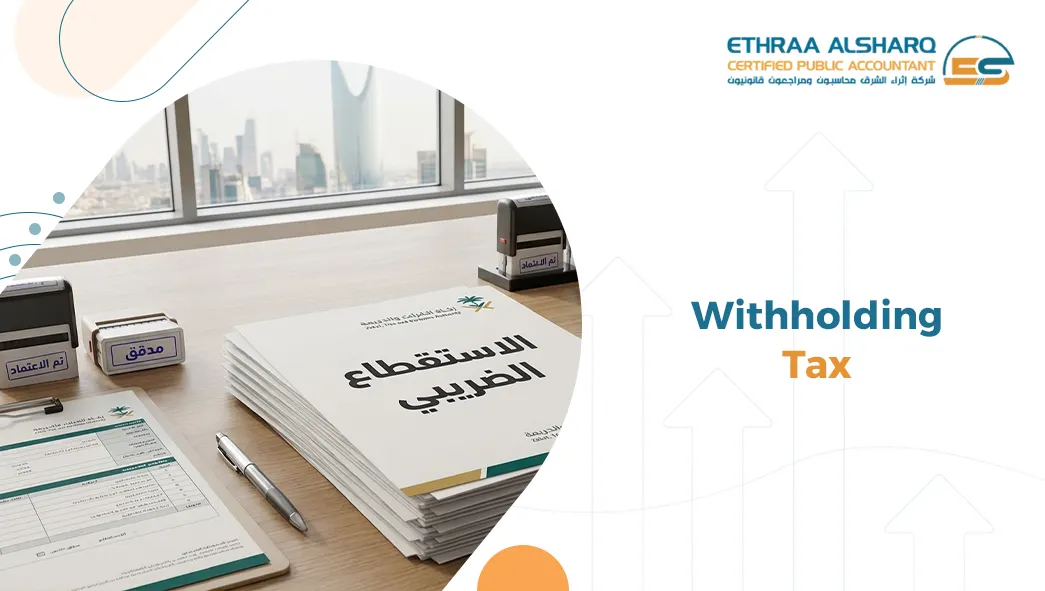
Withholding tax in Saudi Arabia is an essential regulatory tool that ensures the rights of the public treasury. Its management requires legal awareness that goes beyond traditional commercial transactions to avoid any financial setbacks.
Compliance with this tax falls on every resident entity that makes payments to a non-resident party in exchange for specific services, placing the Saudi company in the position of the legally responsible tax collector before the Zakat, Tax and Customs Authority (ZATCA).
Ertiyaa Al-Sharq experts provide you with a comprehensive guide to explore the mechanisms of withholding tax in depth, highlighting safe solutions that ensure your company’s full compliance and protect its cash flows from potential tax risks.
What is Withholding Tax?
Withholding tax is a direct tax imposed on the total payments made from a source in the Kingdom to a non-resident entity (one without a permanent establishment in Saudi Arabia).
The responsibility for withholding this tax and remitting it to ZATCA lies with the paying party (the resident company), within strict statutory deadlines.
When Does Withholding Tax Apply?
Withholding tax applies as soon as a payment is made from a source in the Kingdom to a non-resident entity in exchange for certain services specified by the law. Specifically, the cases of application are as follows:
-
Income source in the Kingdom: The service must be utilized within Saudi Arabia, or the payer must be a resident entity in the Kingdom.
-
No permanent establishment for the supplier: The tax applies when the foreign party does not have a commercial registry or a permanent legal entity in the Kingdom subject to direct income tax.
-
Payments for specific services: Such as consulting fees, technical support services, management fees, or payment for using intellectual property rights.
-
Payment of profits and interest: It also applies when distributing profits to non-resident shareholders or paying interest on loans to foreign banks.
Difference Between Withholding Tax and Value-Added Tax (VAT)
Many businesses get confused when dealing with international suppliers. It is important to distinguish between withholding tax and VAT as follows:
| Comparison Aspect | Withholding Tax (WHT) | Value-Added Tax (VAT) |
|---|---|---|
| Nature of Tax | Direct income tax deducted from the foreign supplier’s income. | Indirect consumption tax imposed on goods and services. |
| Who bears the burden? | Non-resident supplier (deducted from their receivable). | End consumer (the resident company pays it to the supplier). |
| Scope of application | Services, interest, and royalties only. | Goods and services (based on reverse charge mechanism for imports). |
| Legal responsibility | Resident company responsible for withholding and remittance. | Resident company responsible for declaration via reverse charge. |
| Recovery | Non-recoverable (considered a tax cost for the supplier). | Recoverable as input tax if the company is registered. |
Withholding Tax Rates in Saudi Arabia by Type of Service
Rates differ depending on the type of service provided, considering the provisions of double tax treaties. The Saudi system specifies exact rates to ensure tax fairness:
-
Management fees: 20%, including amounts paid for administrative supervision or general management services.
-
Royalties: 15%, relating to intellectual property rights, patents, or trademark usage.
-
Consulting and technical services: 5%, the most common type when hiring international experts.
-
Airfare and shipping tickets: 5% on amounts paid to non-resident airlines or shipping companies.
-
Lease contracts: 5% on rents for assets and equipment from foreign entities.
When is Withholding Tax Due?
The withholding obligation arises at the moment of payment to the non-resident or when recorded in the accounting books (whichever comes first). The resident company must remit the withheld tax to ZATCA within the first 10 days of the month following the month in which the payment was made. Any delay exposes the company to a late penalty of 1% for every 30 days of delay.
Double Taxation Agreements and Their Importance
Saudi Arabia has signed multiple double taxation agreements with various countries. These agreements may allow companies to reduce withholding rates or obtain exemptions in certain cases.
-
Using the agreement: Requires submitting a tax residence certificate for the non-resident entity approved by its local authorities.
-
Advisor’s role: At Ertiyaa Al-Sharq, we help analyze these agreements to ensure no unnecessary payments are made.
Common Mistakes in Withholding Tax Management
Some incorrect practices can cause financial losses due to penalties, including:
-
Company bearing the tax instead of the supplier: If the contract does not stipulate withholding, the company may have to pay the tax from its own funds. A gross-up calculation is necessary to estimate the correct tax.
-
Ignoring small payments: Some think small amounts are exempt, but the law applies to all amounts regardless of size.
-
Late remittance: Failure to comply with the 10-day deadline of the following month.
How to Ensure Your Company Complies with Withholding Tax
-
Review international contracts: Ensure clear clauses specifying who bears the tax burden.
-
Correct service classification: Confusing management fees with technical services can cost a 15% tax difference.
-
Digital archiving: Keep withholding forms (Tax Withholding Form) and payment receipts for inspection purposes.
Handling withholding tax requires accounting accuracy and deep legal understanding of local and international regulations. Anticipating tax issues through correct classification and timely compliance distinguishes financially stable and successful companies.
At Ertiyaa Al-Sharq, our accountants and legal auditors provide technical support for reviewing international contracts and auditing withholding processes to ensure full compliance and maximize the benefits of international tax agreements.
Given the complexity of these obligations, contact us today to evaluate your international payments and safeguard your tax position.
Frequently Asked Questions About Withholding Tax
Does the import of goods from abroad fall under withholding tax?
No. Payments for importing goods are not subject to withholding tax, as the tax applies only to services, interest, and royalties. Goods are subject to VAT and customs duties upon import.
What happens if the company does not withhold the tax from the supplier?
The resident company is the primary party responsible before ZATCA. Failure to withhold requires the company to pay the tax from its own funds plus any resulting late penalties.
Can a non-resident supplier recover withheld tax?
In certain cases and under double taxation agreements, a non-resident supplier may claim a refund for excess withholding, but this requires complex procedures and precise legal proof to ZATCA.
Does withholding tax apply to salaries paid to employees outside Saudi Arabia?
If an employee works for the Saudi company but performs work outside the Kingdom, their salary is usually not subject to withholding tax. However, the contractual relationship should be reviewed to ensure it is not classified as consulting or technical services.