Imagine you are constructing a massive building; every floor you add depends entirely on the strength and stability of the floors beneath it. In the world of finance and business, things work the same way. Each fiscal year does not begin from scratch; rather, it is a continuation of a journey that started on the very first day your business was established.
Here lies the importance of Permanent Accounts. They are the memory of your business—records that do not disappear at year-end but stay with you, telling you where you stand today, what you own, and what you owe tomorrow.
Understanding the difference between what ends at year-end and what continues forward gives you clarity and the ability to make decisions based on cumulative, consistent financial facts.
In this guide, we will take you on a journey that is both simple and in-depth to explore the world of Permanent Accounts and how they intersect with temporary accounts to ultimately form the account balances reflected in your balance sheet.
What Are Permanent Accounts?
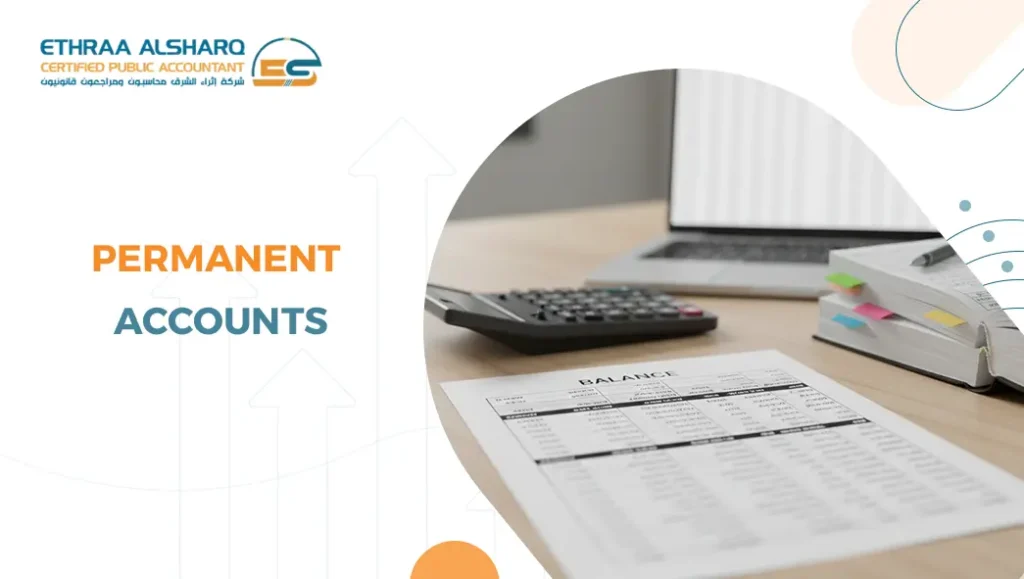
Permanent Accounts, also known as real accounts, are accounts whose balances are not reset at the end of the fiscal year. Instead, Permanent Accounts balances are carried forward from one period to another and continue to appear in the financial statements of the new period as opening balances.
What Is the Difference Between Permanent Accounts and Temporary Accounts in Accounting?
To understand the importance of continuing accounts, it is essential to compare them with temporary accounts:
Temporary Accounts are accounts related to only one financial period (such as revenues and expenses). These accounts are closed and reset to zero at year-end, and their net result is transferred to retained earnings (which is a permanent account).
Nature of the Balance: While temporary accounts start each new year with a zero balance, Permanent Accounts begin the new year with the ending balance from the previous year, ensuring the accumulation of the company’s financial strength over time.
The Role of Permanent Accounts in the Balance Sheet
The balance sheet is the primary financial statement that includes all Permanent Accounts. Their importance is reflected in:
Determining Financial Solvency: They show the organization’s real ability to meet its obligations through its ongoing assets.
Financial Control: Carrying forward balances allows accurate tracking of receivables, payables, and cash flows over time.
Reporting Accuracy: Permanent Accounts ensure that no cumulative financial data is lost when closing the fiscal year.
Types of Permanent Accounts
Permanent Accounts are classified according to the basic accounting equation components and include three main categories clearly presented in the balance sheet:
Asset Accounts
These represent everything the company owns that has future economic value. They are divided into:
Current Assets: Such as cash, accounts receivable (customers), and inventory.
Non-Current Assets: Such as land, buildings, equipment, and intangible assets like software.
Liability Accounts
These represent the company’s obligations to others (debts), including:
Short-Term Liabilities: Such as accounts payable (suppliers) and short-term loans.
Long-Term Liabilities: Such as bonds and long-term bank loans.
Equity Accounts
These represent the residual value belonging to the owners after all liabilities have been settled, including:
Capital: The amounts invested by the owners in the business.
Retained Earnings: Accumulated profits that have not been distributed and are carried forward from previous years.
How to Successfully Carry Forward Account Balances
The carryforward process is a precise accounting procedure that requires ensuring the accuracy of closing entries. The main steps include:
Closing Temporary Accounts: Transferring all income statement items to the income summary account and then to retained earnings.
Trial Balance Verification: Ensuring that total debits equal total credits before moving to the new period.
Opening the New Period: Transferring the final balances of Permanent Accounts to become the opening balances of the next fiscal year.
Practical Tips for Managing Permanent Accounts
To ensure accurate financial reporting and avoid confusion at year-end, consider the following:
Regular Balance Reviews: Do not wait until year-end to reconcile customer and supplier balances. Monthly reviews help maintain accurate Permanent Accounts balances.
Accurate Classification of Expenses and Assets: Ensure capital purchases (such as equipment) are not recorded as regular expenses, as this would incorrectly reset their value at year-end and deprive the balance sheet of permanent assets.
Maintain Backup Copies of the Trial Balance Before and After Closing: This makes it easier to refer back to prior-year balances if any technical issues arise during the carryforward process.
Automate the Carryforward Process: Using reliable accounting systems reduces human errors resulting from manually transferring opening balances.
Common Mistakes in Managing Permanent and Temporary Accounts
Mixing Balance Sheet and Income Statement Items: For example, recording a fixed asset as an expense, which leads to incorrectly eliminating the asset’s value at year-end.
Failure to Make Adjusting Entries: Neglecting to adjust asset and liability accounts before carrying them forward results in transferring inaccurate figures to the next period.
Ignoring Account Reconciliations: Carrying forward balances that do not match bank statements or supplier and customer records.
Proper management of both Permanent Accounts and temporary accounts distinguishes strong accounting systems from weak ones. By focusing on accurate account balances and maintaining continuity in balance sheet accounts, businesses can build a historical financial database that supports long-term strategic decision-making.
Does your accounting system ensure the accurate transfer of balances? Proper account organization is the first step toward financial transparency and sustainable growth. Always review closing and carryforward procedures to ensure the integrity of your financial position each new year.
We offer accounting and accounting supervision services to help you manage Permanent Accounts and temporary accounts, and oversee the closing and transfer of balances.
Frequently Asked Questions About Accounting Accounts
Why Are Balance Sheet Accounts Called Permanent Accounts?
Because they represent the ongoing financial position of the business. They do not reflect the results of a single period only, but rather show what the business owns and owes since its inception.
Is the Owner’s Drawings Account Permanent or Temporary?
The drawings account is typically treated as a temporary account that is closed into the capital account or retained earnings at the end of the fiscal year.