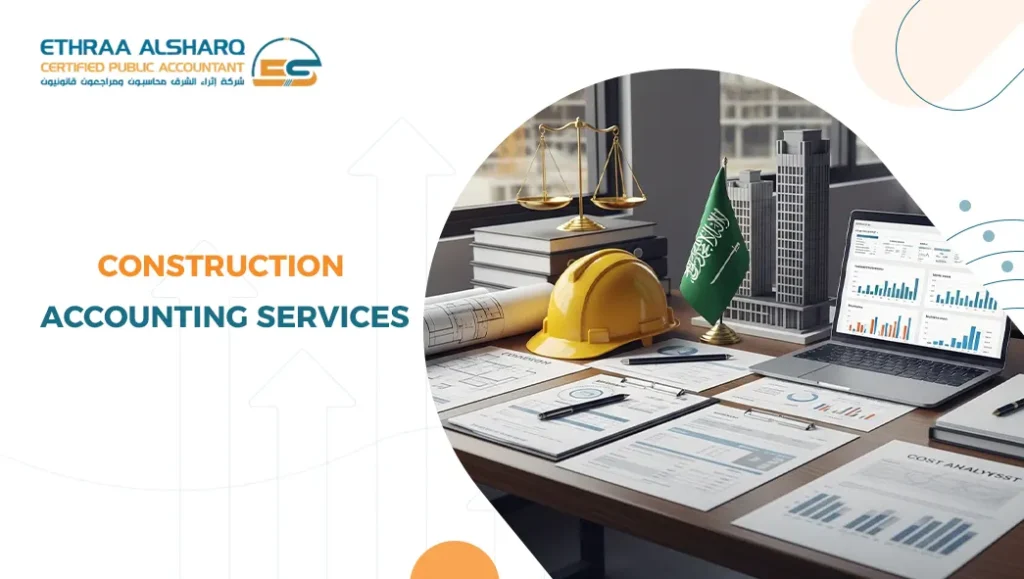
The construction sector is one of the most complex industries from a financial and accounting perspective. A construction company does not sell a single standardized product at a fixed price; instead, it executes multiple projects, each with its own independent budget, timeline, and separate cash flows.
This project-based structure makes traditional accounting unable to provide an accurate picture of financial performance. Construction accounting is therefore a specialized and precise discipline that relies on tracking every riyal spent and every revenue generated, linking each transaction to a specific project.
It is the tool that enables decision-makers to determine whether a particular project is generating profits or losses in time to take corrective action. This is a fundamental element of construction accounting services, ensuring business continuity and alignment with Saudi Arabia’s Vision 2030.
What Are Construction Accounting Services?
Construction accounting services refer to a set of financial and auditing practices specifically designed to manage the temporary and unique nature of construction projects.
Rather than simply tracking overall company profits and losses, these services dive into the operational details of each project site, starting from the tendering and cost estimation stage, through procurement management and labor wages, and ending with progress billing and final collections.
The objective of this accounting approach is to create a precise link between actual expenses and the planned project budget. This ensures strict cost control while maintaining compliance with International Financial Reporting Standards (IFRS) and Saudi local regulations.
The Nature of Project Accounting in Construction Companies
Project accounting in this sector is characterized by detailed accounting for each project individually using the Job Costing method. Each project is treated as an independent cost center where the following are monitored:
Direct costs
These include raw materials such as steel and concrete, on-site labor wages, and subcontractor costs.
Indirect costs
These include depreciation of heavy equipment, salaries of supervising engineers, and transportation and insurance expenses allocated to projects based on defined ratios.
Progress billing management
Tracking milestone payments based on completion certificates and ensuring they match the actual expenditures incurred at the project site.
Why Is Construction Accounting Different from Other Businesses?
Certified public accountants in the construction sector face unique challenges that are not present in traditional commercial activities, including:
Long accounting cycles
Projects may extend over several years, requiring precise revenue recognition according to IFRS 15.
Retention amounts
Handling amounts withheld by clients to guarantee quality of execution.
Variation orders
Managing contract modifications and their impact on the project’s estimated budget.
The Difference Between Accounting for Small Contractors and Large Construction Firms
The size of the business determines the level of financial control required.
Small contractors
Accounting mainly focuses on daily liquidity management, controlling material purchases, and ensuring timely payment of labor wages, with a simplified system for monitoring progress billings.
Large construction firms
Require advanced systems to manage portfolios of multiple projects, analyze variances between estimated and actual budgets, manage complex subcontractor contracts, and produce consolidated tax and zakat reports for branches and project sites.
Financial Challenges in the Construction Sector and How to Address Them
At Ithraa Al-Sharq, we provide specialized solutions to address the most common challenges in this sector.
1) Project Cost Control
We design accounting systems that prevent cost overlap between projects, enabling management to determine the profitability of each project accurately before completion.
2) Cash Flow and Liquidity Management
We assist in scheduling payments to suppliers and collecting progress billings in a way that ensures construction activities are not interrupted due to cash shortages.
3) Tax and Zakat Treatment for Long-Term Contracts
We ensure compliance with the requirements of the Zakat, Tax and Customs Authority (ZATCA) regarding VAT on progress billings and the zakat treatment of construction contracts in accordance with updated Saudi regulations.
4) Subcontractor Management
Organizing financial transactions with subcontractors, from recording advance payments to final settlement of dues based on approved completion percentages.
Key Pillars of a Successful Construction Accounting System
To build a strong financial framework for your company, the following elements must be in place:
A specialized ERP system for construction
Connecting warehouse management, HR systems, and field project sites.
Independent cost centers
Each project is assigned a unique code where every expense and collection is recorded.
Periodic variance reports
Reports that identify differences between planned and actual costs to enable immediate corrective actions.
Digital archiving of contracts and documents
Ensuring easy access to project data during audits or claims.
Make Your Project Numbers a Measure of Success
At Ithraa Al-Sharq – Certified Public Accountants and Auditors, we believe construction accounting is the primary driver of profitability. We provide the professional expertise required to control costs and achieve sustainable growth in the Saudi construction market.
Would you like to control project costs and improve your project cash flow management?
Get a specialized professional consultation for the construction sector today.
(FAQ) About Construction Accounting
What is the importance of project accounting in construction companies?
It provides precise control over the costs of each project independently, allowing companies to compare actual expenses with estimated budgets, identify deviations or waste early, determine the true profitability of each construction project, and manage project-specific cash flows effectively.
How is the percentage of completion calculated in projects?
It is calculated either through the Cost-to-Cost method, which compares actual costs incurred with estimated costs, or through physical inspection of completed work documented through certified progress reports.
What is the best tax treatment for advance payments?
Tax invoices must be issued for advance payments immediately upon receipt, and the related VAT must be reported according to Saudi VAT regulations.
Does a small contractor need project accounting?
Absolutely. Without project accounting, a contractor may generate profits in one project while other projects consume all resources without management realizing it.