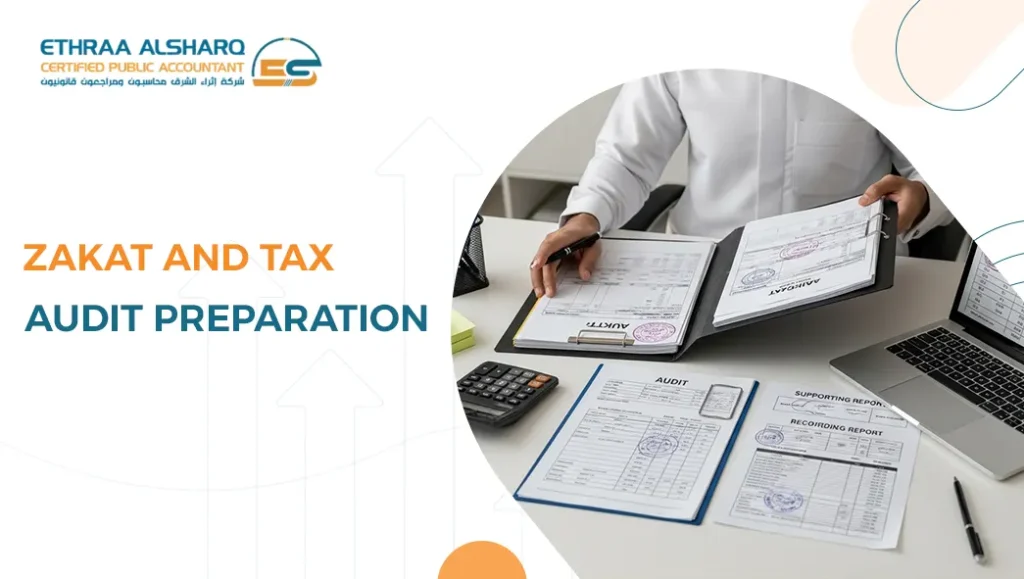
A tax audit is one of the most critical stages in a company’s relationship with the Zakat, Tax, and Customs Authority (ZATCA). The purpose of this audit is to ensure that the business complies with applicable regulations and that submitted returns accurately reflect its financial reality.
Proactive preparation for zakat and tax audits is not just a routine procedure it is a protective shield that helps businesses avoid arbitrary assessments and heavy penalties.
In this article, we outline the key steps to prepare your business to successfully pass any audit with confidence.
What Is a Zakat and Tax Audit?
A zakat and tax audit is a regulatory procedure conducted by ZATCA to review and examine accounting records, invoices, and tax returns submitted by a business over a specific period.
The objective is to verify the accuracy of zakat and tax calculations (such as VAT and withholding tax) and ensure they align with the documented financial records.
Importance of Reviewing Accounts Before an Audit
Pre-audit financial review by professionals is essential to avoid common errors. Its importance includes:
- Identifying accounting discrepancies or misclassifications and correcting them before inspection
- Ensuring all supporting documents are available for each financial transaction
- Evaluating compliance of accounting systems with regulatory requirements
Key ZATCA Requirements During an Audit
When an audit begins, your business must be prepared to provide the following:
- Audited financial statements: Balance sheet and income statement
- Annual trial balance
- Accounting records: General journal and general ledger
- Tax invoices: Supporting sales and purchase transactions
- Bank statements: To reconcile cash flows with accounting records
- Customer and supplier contracts: To validate transactions
- Inventory records: Movement and stock counts
- Tax and zakat returns: Previously submitted filings
- Fixed asset register: Including depreciation details
Steps to Review Accounts Before an Audit
To ensure financial accuracy and avoid penalties, conduct a comprehensive review:
Review Financial Statements
- Verify accuracy of revenues and expenses in the income statement
- Ensure proper valuation of assets and liabilities
Perform Bank Reconciliations
- Match accounting records with actual bank statements
- Resolve any discrepancies immediately
Review VAT Calculations
- Verify collected VAT on sales and input VAT on purchases
- Ensure alignment with submitted returns
Audit Expenses
- Confirm that all expenses are supported by valid invoices
- Ensure they are acceptable for tax purposes
Review Liabilities
- Check balances of suppliers, loans, and other obligations
- Ensure no liabilities are missing
Common Errors Found During Tax Audits
During inspections, auditors often identify issues that may lead to penalties:
- Mismatch between returns and records
- Missing supporting documents
- Incorrect expense classification
- Mixing personal and business transactions
- Relying solely on bank statements instead of accounting records
How Ethraa Al Sharq Supports You During Tax Audits
At Ethraa Al Sharq, Certified Accountants and Auditors, we provide professional support to ensure your readiness:
- Mock audit: Simulating an audit to identify and fix gaps
- Audit file management: Handling communication and responses with ZATCA
- Ongoing compliance: Strengthening your accounting system to meet all regulations
Early preparation and proper organization of financial data are the key to passing audits confidently and avoiding financial risks.
If you want to assess your company’s readiness, our team can help you review your data and fully prepare your audit file.
(FAQ)
What is a tax audit for companies?
It is a regulatory review conducted by ZATCA to verify the accuracy of financial statements and tax returns submitted by a business.
What documents are required for a tax audit?
Audited financial statements, trial balance, accounting records, tax invoices, bank statements, and contracts with suppliers and customers.
Can audit results be challenged?
Yes, businesses can file an official objection within the legal timeframe and escalate if necessary.
What should I do if notified of an audit?
Immediately review your records and ensure alignment with submitted returns, preferably with the help of a tax advisor.
Can ZATCA audit previous years?
Yes, audits can cover up to five years or more in certain cases such as non-compliance or late filings.