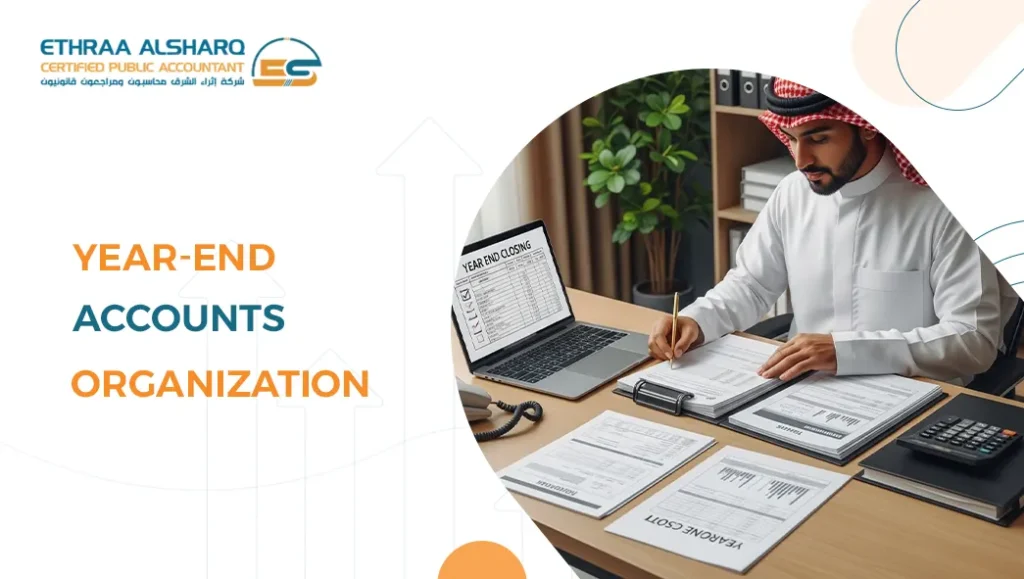
As the fiscal year-end approaches, businesses enter a stage unlike any other period of the year. It is not just another operational phase, but a critical period of gathering, organizing, and reviewing financial records.
The goal is clear: transforming twelve months of daily transactions into accurate and complete financial statements that reflect the company’s true performance.
Some businesses begin organizing their accounts well before year-end, allowing for a smooth and efficient closing process. Others delay until the final weeks, resulting in pressure, accounting errors, and incomplete reviews. Ultimately, the difference does not lie in the size of the business but in having a structured system and a clear year-end closing plan.
What Does Organizing Accounts Before Year-End Mean?
Organizing accounts before year-end is a proactive process aimed at reviewing and arranging all accounting records and journal entries made throughout the year.
The objective is to ensure completeness, accuracy, and compliance with accounting standards before officially closing the books. It is essentially a cleansing process that ensures the new fiscal year begins with reliable financial data and a solid financial position.
The Difference Between Daily Accounting and Year-End Closing
It is important to distinguish between routine accounting tasks and the annual closing process:
Daily Accounting
This involves recording transactions as they occur—such as sales invoices, expenses, and payments—to ensure no financial information is lost.
Year-End Closing
This is an evaluative and corrective process focused on reviewing existing records, making adjustments, and ensuring each account reflects its true balance at a specific point in time.
Key Steps to Organize Your Accounts Before Financial Closing
To achieve a successful and error-free year-end closing, the following steps should be followed:
1. Review and Audit Accounting Entries
This is the first stage of filtering and validating financial data:
- Ensure all transactions have been recorded
- Correct accounting errors and misclassifications
- Prevent duplicate or missing entries through invoice and journal sequence checks
2. Reconcile Accounts and Balances
The goal here is to match accounting records with actual balances:
- Perform bank reconciliations
- Reconcile customer and supplier balances
- Match cash balances with physical cash counts
3. Record Accrued Expenses and Revenues (Accrual Basis)
This ensures that each fiscal year reflects only its own revenues and expenses:
- Apply the accrual accounting principle
- Record unpaid expenses related to the current year
- Adjust deferred revenues received for future services
4. Conduct Inventory and Asset Counts
Protect company assets and ensure proper valuation:
- Perform physical inventory counts
- Verify fixed assets against the asset register
- Resolve discrepancies between physical and recorded balances
5. Calculate Depreciation and Annual Adjustments
This step reflects the reduction in asset value over time:
- Allocate asset costs over useful life
- Apply approved depreciation rates correctly
- Reflect depreciation as a non-cash expense reducing taxable income
6. Review Liabilities and Outstanding Obligations
Ensure all obligations are accurately recorded:
- Verify loan balances and accrued interest
- Confirm zakat, tax, and social insurance provisions
- Record employee entitlements such as salaries and end-of-service benefits
7. Prepare Preliminary Financial Reports
This provides an early overview before finalizing the closing process:
- Draft income statements and balance sheets
- Review cash flow statements
- Analyze profit margins and financial ratios before external audit review
How Ethraa Al Sharq Supports Your Year-End Closing
At Ethraa Al Sharq, Certified Accountants and Auditors, we help businesses simplify and organize the closing process through:
- Reviewing accounting entries and ensuring technical accuracy
- Supervising physical inventory counts and reconciliation procedures
- Preparing financial reports in accordance with IFRS standards
Organizing your company’s accounts is not merely a legal requirement—it is an investment in your business credibility and future growth. Start organizing your financial records today so you can enter the new fiscal year with clarity and confidence.
(FAQ)
What is fiscal year-end closing?
It is the accounting process of closing temporary revenue and expense accounts and transferring net profit or loss to retained earnings in order to prepare final financial statements.
When should account organization begin?
Ideally one to two months before the fiscal year-end to avoid last-minute pressure and ensure accurate records.
Why are reconciliations important?
Reconciliations ensure accounting records match actual balances, preventing discrepancies and inaccurate financial reporting.
Can year-end closing be done without an accountant?
Doing so carries significant risks, including incorrect provisions, IFRS non-compliance, and tax reporting errors.
What is the difference between monthly and annual closing?
- Monthly closing: Focuses on periodic performance review and transaction accuracy.
- Annual closing: Includes comprehensive procedures such as inventory counts, depreciation, provisions, and audited financial reporting.