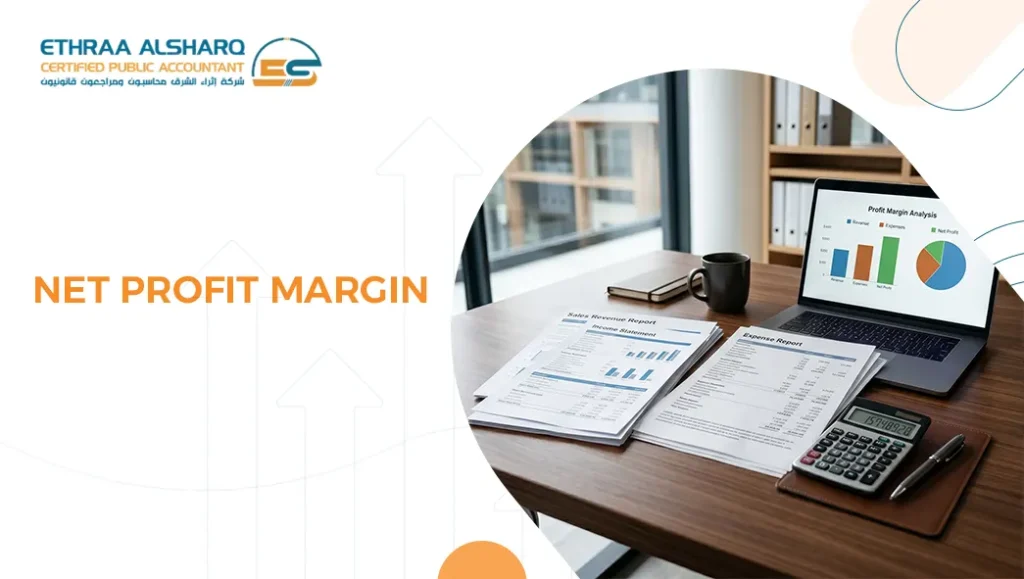
“Sales are for show, profits are for wisdom” is a common saying among accountants. Its deeper meaning is that impressive revenues alone do not create a successful business; rather, success is determined by what remains after all expenses are deducted—what is known as the net profit margin.
Consider a real-world example: a popular restaurant in the heart of Riyadh generates daily revenues of SAR 50,000. The figures appear impressive, but after deducting the cost of meat and vegetables, chefs’ and staff salaries, rent, utility bills, and even the napkins customers use, what remains at the end of the month?
That remaining amount represents the financial reality that determines whether the restaurant is growing or merely draining its owner’s resources.
In this article, we reveal how to measure the true viability of your investments by understanding this critical financial indicator.
What Is Net Profit Margin?
Net profit margin is one of the most important profitability ratios. It measures the percentage of revenue that remains after deducting all expenses, including operating, administrative, financing, zakat, and taxes.
Simply put, it is the indicator that tells you how efficiently your company converts sales into actual profit.
How Is Net Profit Margin Calculated?
The calculation is straightforward, but it requires accurate classification of financial data:
Net Profit Margin = (Net Income ÷ Total Revenue) × 100
Net Income
The final figure shown on the income statement after deducting all costs and expenses.
Total Revenue
The total amount generated from selling goods or providing services before any expenses are deducted.
The resulting percentage is more than just a number; it serves as a diagnostic report that reveals:
- Operational efficiency: How effectively management generates profit from core operations.
- Expense control: The company’s ability to manage administrative and overhead costs while minimizing waste.
- Pricing effectiveness: Whether prices adequately cover costs and generate a healthy margin.
- Business strength: The ability to remain competitive while maintaining profitability.
- Profit sustainability: The company’s resilience against unexpected economic fluctuations.
Key Characteristics of the Net Profit Margin Indicator
This metric serves as a mirror reflecting the overall financial health of an organization.
Comprehensive Efficiency Indicator
It evaluates not only the cost of goods sold but also the efficiency of managing administrative and financing expenses.
Fair Comparison Tool
It enables comparisons between companies of different sizes operating within the same industry.
Risk Measurement Tool
Low margins often indicate that a company may struggle to absorb sudden increases in costs or declines in sales.
Difference Between Gross Profit Margin and Net Profit Margin
Many people confuse these concepts, making it important to clarify the distinction:
Gross Profit Margin
Focuses solely on the relationship between sales revenue and the direct cost of producing goods or services.
Net Profit Margin
Represents the final profitability measure, taking into account all expenses, including salaries, rent, bank interest, and zakat.
| Comparison Aspect | Gross Profit Margin | Net Profit Margin |
|---|---|---|
| Scope of Measurement | Focuses on production efficiency or direct procurement costs. | Measures overall financial and operational efficiency after all expenses. |
| Expenses Included | Deducts only direct product-related costs (COGS). | Deducts all expenses, including administrative, marketing, financing, zakat, and taxes. |
| Primary Use | Evaluates pricing strategy and initial product profitability. | Evaluates overall profitability and investment attractiveness. |
Factors Affecting Net Profit Margin in the Saudi Market
Net profit margin is influenced by several local business factors that require close monitoring to prevent profit erosion, including:
Rising Operating Costs
The impact of fluctuations in energy prices, logistics costs, and labor expenses.
Increasing Administrative Expenses
Uncontrolled expansion of administrative structures or expenditures not directly related to core business activities.
Weak Pricing Strategy
Inability to pass increased costs on to customers due to intense market competition.
Higher Financing Costs
The effect of SAIBOR rates on existing loans, reducing profits available to business owners.
Taxes and Zakat
The impact of zakat obligations and taxes, such as withholding tax or non-recoverable VAT, on final profitability.
Operational Inefficiency
Productivity gaps or resource waste that reduce the final return generated from each riyal of sales.
Why Is Net Profit Margin Analysis Important for Your Business?
The significance of this indicator extends beyond accounting professionals and includes:
Evaluating Management Performance
Determining whether management is controlling expenses effectively.
Attracting Investors
Investors seek companies with stable or growing profit margins.
Strategic Planning
Identifying the most profitable products or services and focusing resources accordingly.
How Can You Improve Net Profit Margin?
Improving profitability requires strategic initiatives that go beyond simply increasing sales.
Control Operating Expenses
Regularly review supplier contracts and improve resource utilization efficiency.
Improve Pricing Strategies
Adopt value-based pricing models rather than relying solely on cost-based pricing.
Enhance Operational Efficiency
The more organized and automated operations become, the lower unnecessary costs will be.
Reduce Waste
Identify and eliminate inefficiencies throughout the supply chain and internal processes.
Manage Fixed and Variable Costs
Convert certain fixed costs into variable costs whenever possible to improve financial flexibility.
Optimize Inventory Management
Reduce storage costs and avoid excess inventory that ties up liquidity.
Restructure Financing
Explore lower-cost financing alternatives or renegotiate existing loans to reduce interest expenses.
How Can Ethraa Al Sharq Help You Analyze and Maximize Profits?
At Ethraa Al Sharq, we go beyond reporting numbers by providing value-enhancing solutions, including:
Financial Performance Reporting
Conducting in-depth analysis of income statements to identify areas of financial leakage.
Operational Efficiency Improvement
Providing practical recommendations to increase workforce and technology productivity.
Cost and Expense Management
Reviewing cost structures and developing plans to reduce waste without compromising quality.
Pricing and Expansion Support
Delivering financial studies that support growth strategies built on strong profitability.
Development of Financial Performance Indicators
Designing real-time management dashboards to facilitate informed decision-making.
Conclusion
In the world of finance and business, high revenues do not necessarily indicate genuine success. Growth that consumes profits can eventually become a financial burden.
Net profit margin is the true reflection of management quality and operational efficiency in transforming sales into sustainable wealth.
Improving profitability does not happen by chance. It is the result of disciplined cost management, strict liquidity control, and sound financial insight that goes beyond traditional bookkeeping.
Is your company experiencing sales growth while profits remain stagnant?
At Ethraa Al Sharq, we leverage our expertise to analyze your financial position and improve your company’s performance efficiency. Contact us today to begin your journey toward maximizing profitability.
Frequently Asked Questions (FAQ)
What Is Net Profit Margin?
Net profit margin is the percentage of net profit remaining from total revenue after deducting all expenses, including taxes and zakat.
How Is Net Profit Margin Calculated?
It is calculated by dividing net income (final profit) by total sales and multiplying the result by 100.
What Is the Difference Between Net Profit and Net Profit Margin?
Net profit is an absolute monetary amount representing the remaining earnings, while net profit margin is a percentage that measures how efficiently a company generates profit relative to its sales volume.
What Is Considered a Good Net Profit Margin?
There is no universal benchmark. A good margin varies by industry. Retail businesses typically operate with lower margins, while software and consulting firms often achieve higher margins. The most important benchmark is outperforming competitors within the same sector.
Does Higher Sales Volume Mean Higher Profit Margins?
Not necessarily. If the cost of generating additional sales rises faster than revenue growth, profit margins may decline despite increasing sales.
How Can Net Profit Margin Be Improved?
By reducing unnecessary expenses, improving operational efficiency, increasing prices based on value delivered, and renegotiating supplier agreements to lower costs.
Why Do Investors Care About Net Profit Margin?
Because it provides an immediate indication of management effectiveness and the company’s ability to generate real cash profits. It also allows investors to compare the efficiency of companies of different sizes within the same industry.