
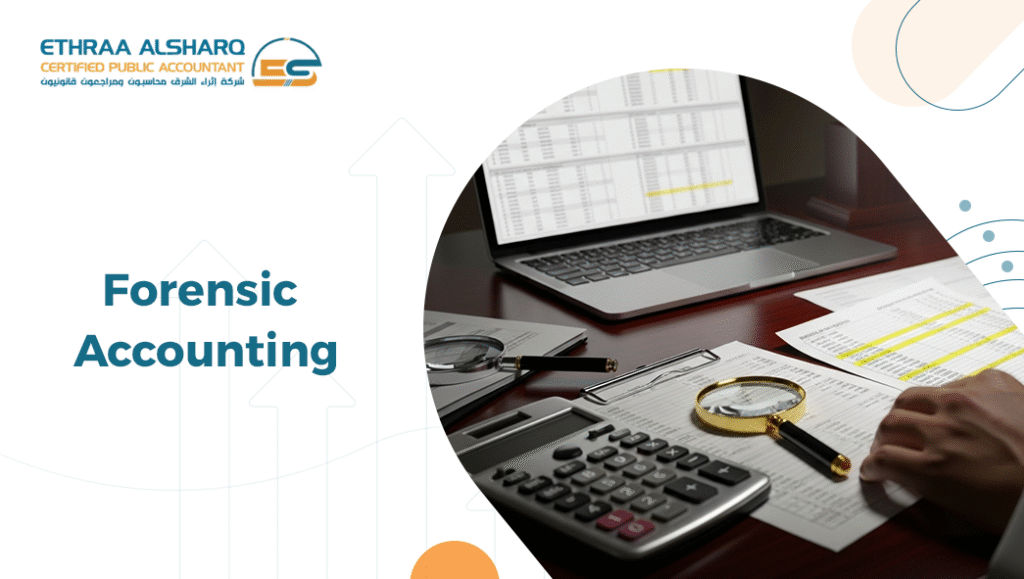
Forensic accounting represents a critical intersection between the worlds of finance and law. Have you ever wondered about the vital role that financial experts play when corporate disputes escalate or when complex financial fraud suspicions arise?
With the rapid development of the Saudi economy and Vision 2030, the accountant’s role is no longer limited to recording transactions; it has expanded to include uncovering the truth and presenting evidence.
Forensic accounting has become a fundamental pillar for ensuring financial integrity and achieving economic justice.
This article is your gateway to understanding this specialized field that combines legal investigative skills with financial auditing. If you want to learn how to protect your company from financial and legal risks, and how a certified accountant can support you in fraud cases, you are in the right place.
What Is Forensic Accounting?
Forensic accounting is a specialized branch of accounting that merges financial expertise, analytical skills, and legal investigation, aiming to uncover fraud and financial manipulation.
It acts as a precise monitoring tool that translates complex financial transactions into clear evidence that can be relied upon before courts and legal authorities.
The forensic accountant becomes a strategic partner for any organization seeking to ensure financial integrity, protect its assets, and strengthen investor trust within Saudi Arabia’s evolving business environment.
Responsibilities of a Forensic Accountant
The forensic accountant’s role goes beyond traditional accounting and auditing functions, becoming a specialized financial investigator whose goal is to uncover facts and present them as legal evidence. Key responsibilities include:
Analyzing financial records and data to detect suspicious or unlawful activities.
Providing accurate financial evidence that can be relied upon before judicial and legal bodies.
Assessing financial damages and calculating compensation in legal and commercial disputes.
Providing expert financial testimony to support legal and criminal cases.
Reviewing financial procedures to ensure compliance with laws and regulations.
Preparing detailed financial reports that assist in resolving disputes and protecting the interests of all parties involved.
To understand the true value of this role, it is essential to identify the core differences between a forensic accountant and a traditional financial accountant.
The Difference Between a Financial Accountant and a Forensic Accountant
Although both financial and forensic accountants share the same academic foundation of numbers and accounting principles, their roles, purposes, and timing of work differ significantly.
A financial accountant focuses on the future and business continuity, while a forensic accountant focuses on the past and uncovering the truth for litigation purposes.
Financial Accountant: Focuses on recording daily transactions, preparing financial statements, and ensuring data accuracy for administrative and tax purposes. Their main role relates to internal control and improving the organization’s financial performance.
Forensic Accountant: Specializes in financial investigation and legal analysis to uncover fraud and financial manipulation. They translate financial data into evidence that can be used before courts and support legal and commercial disputes.
Core difference: While the financial accountant focuses on account management and improving performance, the forensic accountant works on protecting the company legally and uncovering financial risks and illegal practices.
Scope of work: A financial accountant usually works within the organization, while a forensic accountant deals with legal cases and investigations for companies or judicial authorities.
In addition to its strategic importance in fraud detection, forensic accounting in the Kingdom faces unique challenges that require deep and up-to-date legal and technical knowledge.
The Importance of Forensic Accounting in Detecting Financial Fraud
Forensic accounting is the most effective tool in combating the growing and increasingly complex forms of financial fraud. Its importance lies in its ability to:
Analyze financial evidence with high accuracy to detect suspicious or unjustified transactions.
Uncover sophisticated fraud schemes that traditional auditing may not detect.
Document financial operations professionally in a manner that is admissible before judicial bodies.
Identify responsibilities and parties involved in embezzlement or manipulation.
Provide unbiased technical reports that help judges and lawyers understand the financial aspects of the case.
Support administrative and legal decisions by providing reliable financial information that helps management assess risks and handle disputes efficiently.
Reduce potential losses by identifying weak points in the financial cycle, enabling organizations to take preventive actions.
Accurately assess financial damages to support compensation claims.
Prevent repeat fraud by providing recommendations to improve internal controls.
Enhance integrity and transparency through objective and independent examination.
Support criminal investigations with organized digital and financial evidence.
Speed up dispute resolution by offering clear financial interpretations of events.
Given the significant role of forensic accounting in fighting fraud, it is important to highlight the major challenges that forensic accountants face in the Kingdom.
Major Challenges Facing Forensic Accountants
Forensic accountants in Saudi Arabia face a set of complex challenges requiring advanced skills and continuous awareness of legal and technical developments:
Difficulty accessing information due to concealed evidence or manipulated financial records.
The complexity of financial cases that require in-depth analysis of large, intertwined transactions—especially in major corporations or cross-border cases.
Internal resistance from employees or departments when investigating violations affecting their interests.
Legal and time pressure, as some cases require precise results within short timeframes to support judicial proceedings.
Gaps in systems and controls that may hinder the ability to fully track financial transactions.
The need for multi-disciplinary expertise, combining accounting, legal, and investigative skills simultaneously.
Conflicts of interest when dealing with different parties in commercial or criminal disputes.
To overcome these challenges and ensure the highest levels of integrity and investigation quality, the role of specialized accounting firms becomes essential.
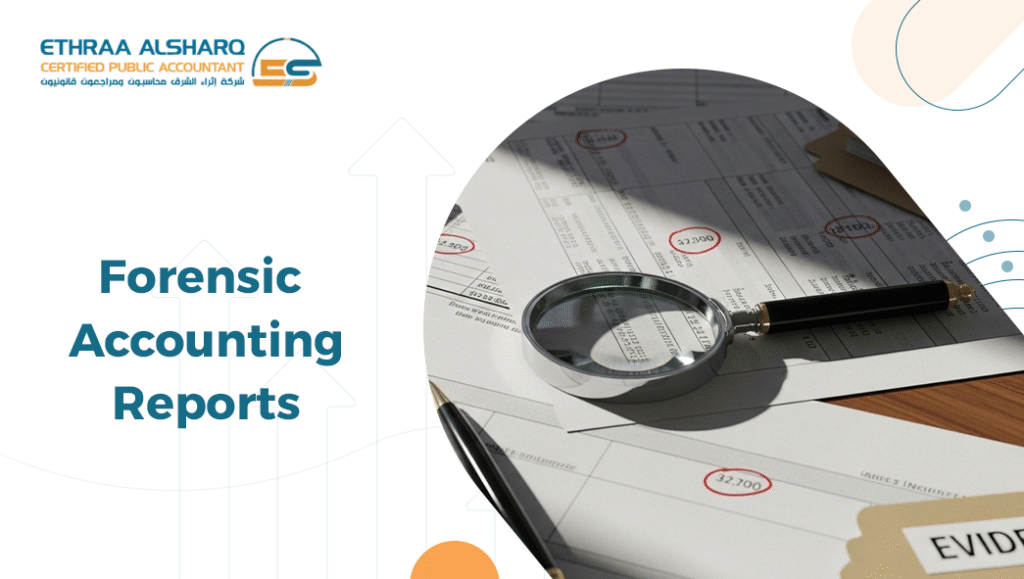
The Role of the Accounting Firm in Forensic Accounting Services
A specialized accounting firm plays a central role in supporting financial investigations and enhancing integrity within organizations by providing advanced expertise in data analysis and identifying irregularities.
The firm develops precise examination methodologies based on modern financial analysis tools, helping uncover illicit activities and document evidence according to established legal standards—highlighting the importance of choosing a specialized and certified accounting firm.
The accounting firm also prepares strong, court-ready reports and provides technical advice to management on addressing financial weaknesses and improving internal controls.
Working with a trusted accounting firm is essential for protecting companies from fraud, supporting them in commercial disputes, and strengthening investor confidence through transparent and reliable financial information.
Why Choose Ethraa Al Sharq Certified Accountants for Forensic Accounting?
Because forensic accounting requires a blend of precision in financial analysis and deep understanding of legal and regulatory frameworks, choosing the right firm is crucial. Ethraa Al Sharq stands out as a reliable choice for the following reasons:
Specialized Expertise in Financial Cases and Commercial Disputes
The team at Ethraa Al Sharq possesses extensive experience in preparing court-approved accounting and forensic reports, including:
Analyzing financial claims and documents between disputing parties.
Examining banking, financial, and accounting records.
Preparing professional technical reports that meet the requirements of courts and official authorities.
Commitment to Forensic Accounting Professional Standards
All forensic accounting engagements are carried out in accordance with the Forensic Accounting Services Engagement Standard issued by SOCPA, ensuring:
Professional and approved methodology.
Full documentation of examination and analytical procedures.
Technical reports that can be defended before judicial authorities.
Full Independence and Objectivity in Expert Opinions
Ethraa Al Sharq maintains full independence and neutrality when evaluating financial evidence and forming professional opinions, reinforcing trust among courts and stakeholders.
Accurate Financial Analysis Using Advanced Tools
The firm uses advanced technologies for financial data analysis, including:
Tracking banking and electronic transactions.
Analyzing cash flows and suspicious activities.
Verifying potential manipulations or inflated invoices and claims.
Professional Communication and Coordination with Judicial Authorities and Lawyers
Ethraa Al Sharq excels in presenting findings in clear, legally structured, and professionally sound language, while providing technical support to lawyers during litigation when needed.
Issuing Professional and Certified Reports
Final reports are delivered in a structured and precise technical format that includes:
Scope of work and applied procedures.
Detailed financial analysis.
Professional findings and conclusions.
A final expert opinion supported by evidence.
Strong Reputation and High Professional Credibility
Ethraa Al Sharq, as a certified accounting firm, enjoys a strong professional reputation with judicial authorities and regulatory bodies and is recognized as a trusted reference for preparing forensic accounting reports in commercial and financial disputes.
By choosing Ethraa Al Sharq Certified Accountants, you ensure accurate, certified financial analysis and an independent, objective expert opinion.
Conclusion
It is clear that the role of the forensic accountant is crucial as a first line of defense and a skilled financial investigator supporting the investment environment in Saudi Arabia. Research and professional practice confirm that this specialization goes beyond traditional accounting boundaries to become a decisive tool in detecting financial fraud, identifying responsibility, and presenting conclusive evidence in courts.
Despite challenges such as case complexity and the shortage of specialized talent, investing in the services of a specialized accounting firm is an essential preventive strategy.
Through accumulated expertise and precise methodologies, such a firm can ensure the highest levels of financial integrity and legal compliance, supporting Saudi Arabia’s Vision 2030 in building a transparent and fair economy.
Frequently Asked Questions About Forensic Accounting
What is the difference between forensic accounting and traditional accounting?
Traditional accounting focuses on recording transactions and preparing financial statements, while forensic accounting aims to investigate financial irregularities, uncover fraud, and provide evidence to support legal cases.
When do companies need a forensic accountant?
Companies turn to a forensic accountant when there is suspicion of fraud or financial manipulation, when disputes arise between partners or commercial parties due to financial or personal transactions, or when there is a need to assess financial damages.
What are the essential skills a forensic accountant should have?
A forensic accountant must possess a combination of accounting knowledge, financial analysis skills, and financial investigative techniques, in addition to strong understanding of laws and regulations governing commercial transactions.
How does an accounting firm support fraud cases?
A specialized accounting firm assists by analyzing financial data, identifying weaknesses, documenting evidence according to legal standards, and preparing reports that can be relied upon by judicial and regulatory authorities.
What are the main challenges facing forensic accountants?
Key challenges include difficulty accessing information, the complexity of financial cases, time pressure, employee resistance, and the wide range of multidisciplinary skills required to conduct investigations accurately.