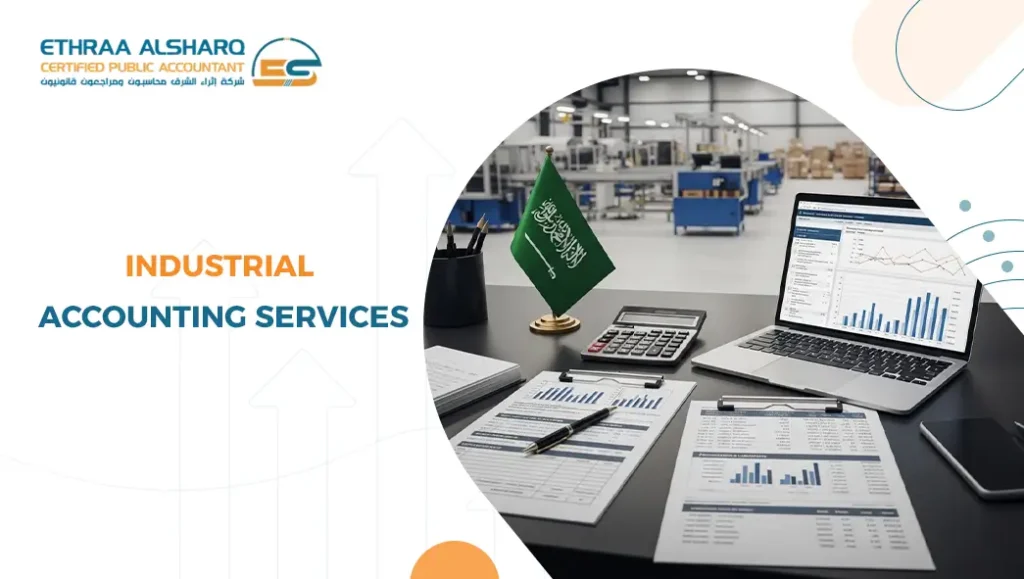
Accounting in the industrial sector focuses on controlling operational processes and guiding production and pricing decisions based on accurate data.
A factory that operates with an advanced accounting system can accurately determine the cost of producing each unit, identify waste within production lines, and analyze the impact of fluctuations in raw material prices on net profits over the long term.
Industrial accounting services represent an integrated financial and technological system for measuring performance and analyzing resource efficiency. They transform raw operational data into clear financial indicators that support expansion and sustainability decisions while ensuring efficient cash flow management that prevents production disruptions caused by liquidity shortages or inaccurate estimation of fixed and variable costs.
What Is Cost Accounting in the Industrial Sector?
Factory accounting differs from traditional commercial accounting due to its strong focus on cost accounting. It is a system designed to track the journey of raw materials from the moment they enter the warehouse, through production stages such as labor, electricity consumption, and machinery depreciation, until the final product is ready for sale.
This process helps determine the appropriate selling price, reduce waste in raw materials, and identify the break-even point after which the factory begins to generate actual operating profits.
How Does Factory Accounting Differ from Other Sectors?
The industrial sector has characteristics that make its accounting more complex and precise.
Triple inventory structure
Inventory is not limited to a single category but includes raw materials, work in progress, and finished goods, each requiring a different accounting treatment.
Indirect costs
Allocating costs such as rent, machine maintenance, and factory administration to produced units requires high precision to avoid incorrect product cost estimation.
Industrial project accounting
In the case of custom manufacturing, project accounting becomes essential to track the cost of each order separately and evaluate its profitability.
The Difference Between Accounting for Small Factories and Large Industrial Complexes
The size of an industrial entity requires different accounting approaches in terms of detail and financial control.
Small factories
Accounting focuses primarily on controlling direct costs such as materials and labor, managing liquidity to ensure continuous operations, and simplifying inventory procedures in line with the limited volume of stock.
Large industrial complexes
These require advanced systems for managing multiple cost centers, accurately analyzing standard cost variances, and managing complex supply chains. They also include accounting for depreciation of large capital assets, preparing financial sustainability reports, and ensuring technological integration between branches and central management.
Financial Challenges in Industrial Companies and How to Address Them
At Ithraa Al-Sharq we understand the challenges facing factory managers and provide practical solutions including the following.
1. Controlling Production Costs and Waste
We assist in establishing a strict control system that reduces raw material waste and analyzes variances between standard costs and actual production costs.
2. Project and Custom Order Accounting
If your factory operates on a custom order basis, we provide a system that tracks the costs of each project separately, ensuring that orders are priced in a way that guarantees profitability.
3. Liquidity and Cash Flow Management
We help schedule payments to suppliers and manage receivable collections in a way that maintains balanced cash flow management, particularly for long-term industrial projects.
4. Compliance with Zakat, Tax, and Electronic Invoicing
Ensuring that all factory invoices and credit notes comply with the electronic invoicing system requirements issued by the Zakat, Tax and Customs Authority while preparing accurate Value Added Tax reports and zakat declarations.
Components of a Successful Industrial Accounting System
To build a strong financial system for your factory, the following elements should be available.
Integrated ERP system
A system that connects warehouse management, human resources, production lines, and financial management.
Cost center for each department
Allowing the efficiency of each production stage to be measured independently.
Periodic and continuous inventory reports
Ensuring that quantities of raw materials and finished goods match accounting records.
Operational dashboard
Providing real-time visibility of profit and loss results and daily production volumes.
The Role of Professional Accounting in the Growth of Factories
The purpose of appointing a specialized Certified Public Accounting firm for the industrial sector goes beyond tax compliance. It also enables factories to benefit from the following.
Accurate profit and loss calculations
Determining the real profit margin of each production line instead of relying on aggregate numbers that may hide losses in certain product categories.
Effective cash flow management
Ensuring the availability of liquidity required to purchase raw materials and pay salaries on time while preventing capital from being tied up in stagnant inventory.
Financial analysis of equipment
Supporting well-informed decisions regarding replacing old machinery or purchasing new production lines based on feasibility studies and projected cash flows.
Transform Your Factory into a Profitable Financial System
If you manage an industrial facility in Saudi Arabia, specialized industrial accounting services designed according to the nature of your operations provide you with clear financial visibility that supports your strategic decisions.
Contact Ithraa Al-Sharq Certified Public Accountants and Auditors to build an industrial accounting system that accurately reflects your operational reality.
(FAQ) About Industrial Accounting
How are overhead costs allocated to products?
They are allocated by identifying cost drivers such as machine hours or labor hours to ensure a fair distribution that reflects the actual consumption of each product.
What is the difference between fixed and variable costs in factories?
Variable costs change with production volume such as raw materials, while fixed costs remain constant such as factory rent. Understanding the difference between them is essential for accurate profit and loss calculations.
Does a small factory need project accounting?
Yes. If the factory produces customized orders with different specifications, project accounting is the only method that ensures each order generates independent profitability without consuming factory resources without return.