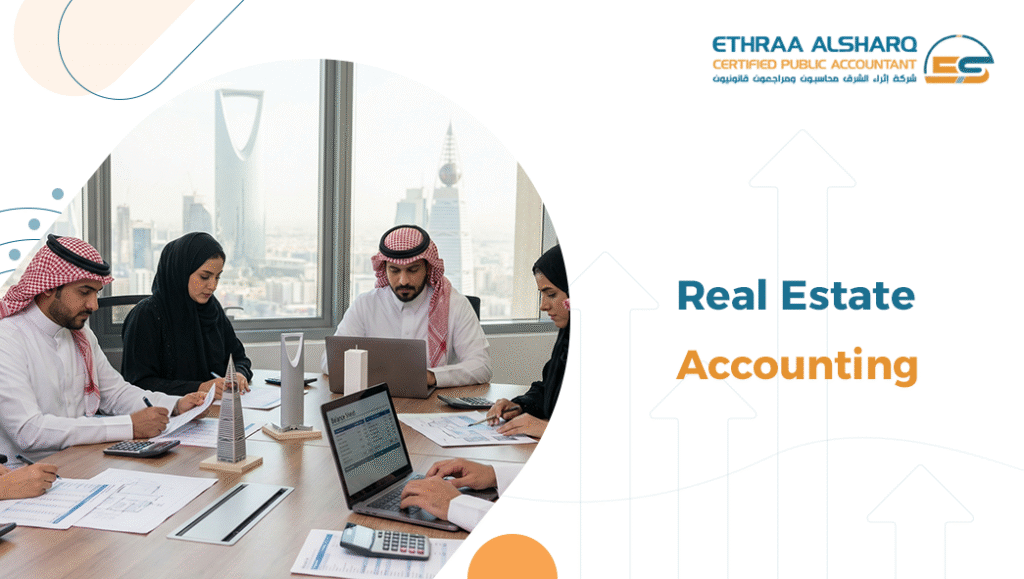
The real estate sector in the Kingdom of Saudi Arabia is experiencing rapid growth, driven by major development projects and expanding investment opportunities.
With this momentum, managing the financial aspects of real estate projects has become increasingly complex, making the need for accurate and professional real estate accounting systems more critical than ever. Real estate accounting is no longer limited to recording financial transactions; it has evolved into a strategic tool that supports cost analysis, risk assessment, and efficient project management.
Through reliable financial reports and clear numerical insights, developers and companies can enhance planning capabilities, improve decision-making, and achieve higher returns in a highly competitive market.
What Is Real Estate Accounting?
Real estate accounting is a specialized branch of accounting focused on recording, analyzing, and monitoring financial transactions related to real estate projects across all stages—from land acquisition and development to construction, asset management, leasing, and eventual property sales.
It provides accurate financial data that supports investors and developers in making sound investment decisions while ensuring transparency in financial reporting for regulatory bodies and financiers.
This is achieved through advanced accounting systems capable of handling complex operations and producing reliable reports that reflect the actual performance of real estate projects.
Difference Between Traditional Accounting and Real Estate Accounting
Traditional Accounting:
Focuses on recording daily revenues and expenses for businesses in general, without in-depth tracking of long-term projects or development stages of assets.
Real Estate Accounting:
Requires detailed monitoring of each project phase, including:
-
Analysis of direct and indirect costs
-
Financial risk assessment
-
Cash flow management during construction and development stages
-
Preparation of detailed financial reports to support investment decisions and long-term planning
Real estate accounting is therefore more specialized and aligned with the nature of long-term projects, while traditional accounting is better suited for general day-to-day operations.
Based on this specialization and fundamental difference, real estate accounting emerges as a critical factor in ensuring project success and sustainability.
The Role of Real Estate Accounting
Real estate accounting plays a vital role in supporting the success of real estate projects and enabling sound investment decisions through:
-
Cost Analysis and Return Estimation: Accurately identifying project costs and forecasting future financial returns.
-
Supporting Investment Decisions: Providing reliable financial data to help investors and developers make informed decisions.
-
Cash Flow Management: Monitoring revenues and expenses to ensure liquidity at every project stage.
-
Budget Control and Variance Analysis: Identifying deviations from planned budgets and taking timely corrective actions.
-
Enhancing Transparency for Investors and Lenders: Delivering trustworthy financial reports that strengthen confidence and attract financing.
-
Compliance with Financial and Regulatory Standards: Ensuring adherence to relevant accounting standards and supporting internal and external audits.
-
Improving Resource Efficiency: Reducing financial waste and optimizing resource utilization through detailed project monitoring.
These critical functions highlight why real estate accounting is indispensable.
Importance of Real Estate Accounting
Real estate accounting is a strategic tool for managing real estate projects efficiently, and its importance can be summarized as follows:
-
Supporting Large-Scale Investments: Managing and tracking billions of riyals accurately in major development projects.
-
Managing Financial Complexity: Handling complex financial operations—such as financing, leasing, valuation, and sales—with professionalism and precision.
-
Strategic Decision-Making: Providing reliable data to analyze profitability and make calculated investment decisions that ensure project feasibility.
-
Regulatory Compliance and Risk Reduction: Facilitating compliance with local accounting standards and significantly reducing legal and financial risks.
-
Enhancing Transparency and Trust: Building credibility with investors and financing institutions through detailed and transparent financial reporting.
-
Optimizing Resource and Budget Management: Supporting budget planning and cash flow monitoring to ensure optimal use of available resources.
To achieve this level of importance and manage the financial complexity and scale of real estate projects efficiently, reliance on modern tools and advanced real estate accounting technologies has become essential to ensure accuracy and speed.
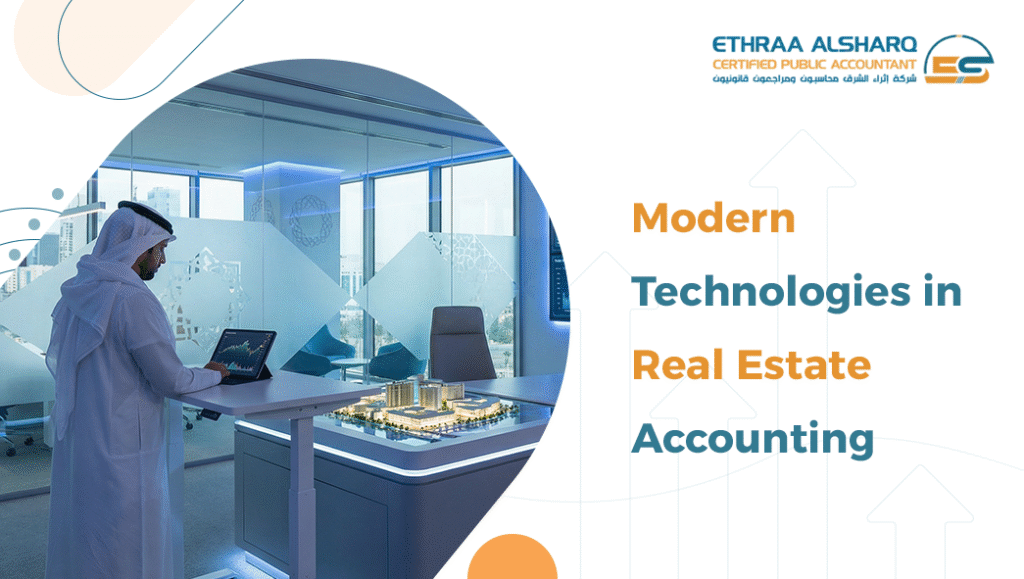
Key Modern Tools and Technologies in Real Estate Accounting
To simplify financial complexity and ensure accuracy, modern tools and technologies have become essential in real estate accounting. The most prominent include:
Cloud-Based Accounting Systems:
Enable real-time access to financial data and facilitate the management of accounts and projects from any location.
Real Estate Project Management Software:
Assists in tracking construction and development stages, monitoring costs, and automatically generating financial performance reports.
Financial Data Analysis Tools:
Provide accurate analyses to assess returns and risks, supporting investment decisions based on reliable data.
Digital Dashboards:
Display key financial performance indicators in a visual and easy-to-understand format, enabling efficient project monitoring and quick decision-making.
Accounting Process Automation:
Reduces manual errors by automating data entry, invoice processing, and journal entries.
Integration with Financing and Tax Systems:
Ensures compliance with financial and regulatory standards by linking internal accounting data with official authorities.
Despite the significant improvements these tools have brought to real estate accounting efficiency, the sector continues to face challenges that require clear strategies to overcome.
Key Challenges in Real Estate Accounting and How to Overcome Them
Real estate accounting faces several challenges due to the long-term and complex nature of projects. The most common challenges and their solutions include:
Complexity of Recording Financial Transactions:
Real estate projects involve multiple stages and suppliers, making accurate tracking difficult.
Solution: Implement integrated accounting systems and project management software to ensure precise and transparent recording of all transactions.
Cash Flow Management:
The need to monitor revenues and expenses across different construction and development phases.
Solution: Prepare detailed cash flow plans and review them regularly to avoid liquidity shortages.
Accurate Asset Valuation and Risk Assessment:
Difficulty in determining the value of land, buildings, and associated project risks.
Solution: Rely on accurate financial valuation reports and specialized feasibility studies to support investment decisions.
Compliance with Standards and Regulations:
Adhering to Saudi accounting standards and Zakat and tax requirements remains an ongoing challenge.
Solution: Regularly update accounting policies and engage specialized real estate accounting experts to ensure full compliance.
Coordination Between Different Teams:
The need to integrate data across development, finance, and accounting teams.
Solution: Use integrated ERP systems and interactive dashboards to connect data and enhance collaboration.
Overcoming these challenges requires more than tools alone—it demands specialized expertise. This is where specialized accounting firms emerge as strategic partners in ensuring real estate project success.
The Role of Specialized Accounting Firms in Real Estate Project Success
Specialized accounting firms play a pivotal role by providing in-depth financial expertise that ensures data accuracy and supports sound decision-making. They assist investors and developers in:
Preparing detailed financial reports that support strategic planning.
Monitoring budgets and costs to ensure optimal resource utilization.
Analyzing financial risks and offering well-considered recommendations to minimize potential losses.
Ensuring compliance with accounting standards and Zakat and tax requirements, while enhancing transparency for investors and regulatory bodies.
How Does Ethraa Al Sharq Support Real Estate Investors and Developers?
Ethraa Al Sharq Certified Accountants and Legal Auditors provides specialized services to support real estate projects, including:
Preparing accurate financial reports for real estate projects and analyzing financial performance.
Managing cash flows and monitoring financial variances to ensure projects are executed according to plan.
Preparing financial feasibility studies and return evaluations to facilitate informed investment decisions.
Providing financial consulting and audit services to ensure compliance with accounting standards and financial regulations.
Conclusion
Real estate accounting is a vital and specialized discipline within the Saudi real estate sector. It differs fundamentally from traditional accounting by focusing on tracking and analyzing complex financial operations across all stages of real estate projects—from acquisition to sale.
Its importance lies in cost analysis, cash flow management, supporting investment decisions, and ensuring compliance with financial and regulatory standards.
Given the scale of real estate investments, reliance on modern tools and technologies—such as cloud-based systems, specialized project management software, and accounting automation—has become essential.
To overcome key challenges such as transaction complexity, cash flow management, and accurate asset valuation, engaging specialized accounting firms is no longer optional.
Firms such as Ethraa Al Sharq provide the expertise required to prepare detailed reports, analyze risks, and ensure compliance—supporting strategic planning and ensuring the success and sustainability of real estate projects.
Frequently Asked Questions About Real Estate Accounting
What is real estate accounting?
Real estate accounting is a specialized discipline focused on recording, analyzing, and monitoring financial transactions related to real estate projects across all stages—from land acquisition to sale—providing accurate data to support sound investment decisions.
What is the primary role of real estate accounting in projects?
Its role centers on cost analysis and return estimation, managing and monitoring cash flows and budgets, supporting investment decisions, and enhancing transparency for investors.
Why is real estate accounting critically important in Saudi Arabia?
Its importance stems from the need to manage financial complexity and large-scale investments in major projects while ensuring compliance with accounting standards and Zakat, Tax, and Customs Authority requirements.
What are the most important modern technologies used in real estate accounting?
These include cloud-based accounting systems, specialized real estate project management software, financial data analysis tools, and digital dashboards.
How can the challenge of complex transaction recording be addressed?
By using integrated accounting systems (such as ERP) and project management software to accurately and transparently record transactions and connect data across teams.
What role do specialized accounting firms play in real estate project success?
They provide in-depth expertise to ensure compliance with standards, analyze risks, prepare detailed financial reports, and offer consulting services that support strategic planning.