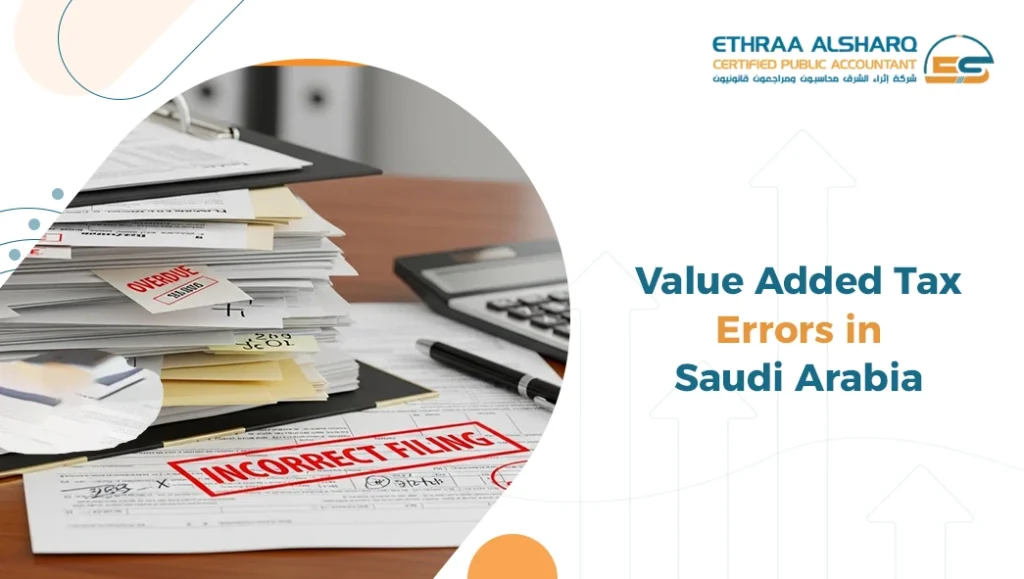
Value Added Tax (VAT) errors represent one of the greatest challenges facing businesses in the Kingdom, as even a minor slip in data entry or invoice classification may result in substantial financial penalties.
With the Zakat, Tax and Customs Authority moving toward full automation through electronic invoicing, precise compliance and the avoidance of such violations have become a strategic necessity essential to business sustainability and financial stability.
Let us shed light on the most common errors and how to professionally handle VAT violations.
What Are VAT Errors?
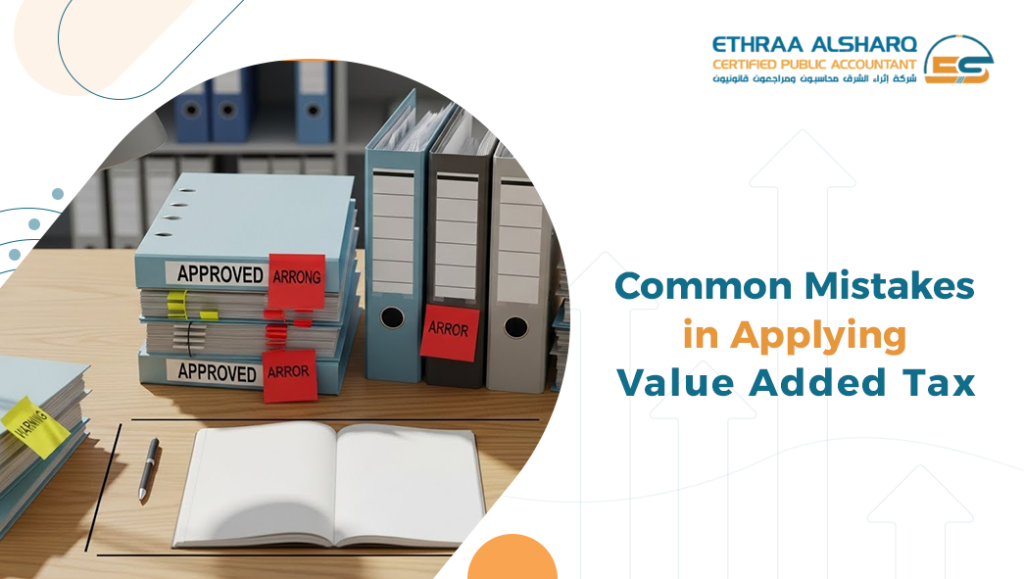
From a regulatory perspective in the Kingdom, VAT errors are defined as any discrepancy or inaccuracy in recording and remitting the tax amounts due to the Authority, whether by excess or deficiency. It is important for taxpayers to distinguish between two main types of such errors:
Unintentional errors:
These arise from calculation mistakes, incorrect data entry, or a simple misunderstanding of how items should be allocated in the return. This type is usually handled through amended returns, without severe penalties, provided the taxpayer takes the initiative to correct it.
Regulatory violations (or evasion):
These are explicit breaches of the Implementing Regulations, such as failing to issue a tax invoice, deducting ineligible input tax, or deliberately concealing sales. Such cases expose the establishment to tax violation penalties or tax evasion sanctions.Types of VAT Errors
To achieve full compliance, businesses must avoid falling into the following common error patterns:
VAT Registration Errors
These are early-stage but high-risk errors because they incorrectly establish the relationship between the business and the Authority:
-
Late mandatory registration: Exceeding the revenue threshold without applying for registration.
-
Incorrect registration details: Inaccurate activity data, start date, or contact information.
-
Failure to update information: Neglecting to notify the Authority of structural changes (such as a change of address or business activity).
Impact: These errors directly lead to late registration penalties and loss of compliance status.
Tax Invoice Errors
Invoices are the primary legal document, and any defect in them is among the most common causes of violations:
-
Issuing invoices that do not meet statutory requirements due to missing mandatory data.
-
Errors in the tax registration number, whether incorrect or inactive.
-
Failure to separate tax, presenting the total price without clearly stating the VAT amount separately from the value of the supply.
-
Electronic invoicing errors, including non-compliance with the technical requirements of the integration and connectivity phase.
-
Misuse of simplified tax invoices in cases that require a full tax invoice.
Tax Return Errors
This is the most critical stage periodically reviewed by the Authority. Common mistakes include:
-
Incorrect data entry: Misallocating output (sales) or input (purchases) amounts in the designated fields.
-
Deducting ineligible tax: Attempting to deduct input tax on prohibited goods or items unrelated to the economic activity.
-
Reconciliation differences: Discrepancies between the amounts reported in the return and the actual invoice records.
-
Carryforward errors: Incorrect transfer of credit or debit balances from one tax period to another.
-
Late filing: Submitting the return after the statutory deadline.
Supply Classification Errors
Incorrect classification directly affects your financial obligations and your ability to deduct input tax:
-
Mixing supply types: Inability to distinguish between standard-rated supplies (15%), zero-rated supplies, and exempt supplies.
Impact: Misclassification may deprive you of the right to deduct input tax, expose you to penalties due to under-collected tax, and negatively affect the outcome of any future tax audit.
These errors go beyond mere accounting deficiencies and directly expose businesses to the statutory consequences prescribed by the Implementing Regulations.
VAT Violations and Penalties
The Authority has established strict regulations to ensure compliance. Penalties and financial obligations vary depending on the type and nature of the violation, including:
-
Penalty for failure to register: Imposed on businesses that exceed the mandatory registration threshold without submitting a formal registration application within the prescribed timeframe.
-
Late filing penalty: Applied when the statutory deadline for submitting the periodic VAT return is exceeded, usually calculated as a percentage of the tax due.
-
Invoice-related penalties: Resulting from issuing non-compliant invoices, failing to meet electronic invoicing requirements, or including incorrect tax data.
-
Tax evasion or concealment of sales: The most severe penalty, applied in cases of deliberate submission of misleading information or concealment of actual supplies to reduce tax liability, exposing the business to legal accountability and substantial fines.
How to Correct Tax Return Errors
If a business discovers an error in a previously submitted return, the system allows correction in accordance with the following rules:
-
Prompt correction: Submitting an amended return before the Authority discovers the error reduces the likelihood of severe penalties.
-
Timely amendment: The correction request must be submitted immediately upon discovering the error to ensure compliance.
-
Document retention: Maintain all invoices and accounting entries supporting the correction for purposes of tax audit review.
How Can Your Business Reduce VAT Errors?
Preventing tax errors is far better than correcting them after the fact. Key practical steps include:
-
Rely on electronic invoicing: Use certified accounting software that automatically complies with Authority requirements, reducing human intervention and calculation errors.
-
Periodic document review: Conduct monthly reviews of issued and received invoices to ensure all tax data is complete before filing the return.
-
Accurate supply classification: Ensure the accounting team fully understands the distinction between 15% taxable goods, exempt supplies, and zero-rated supplies.
-
Follow Authority updates: Stay informed of any changes to the Implementing Regulations or deadlines to ensure continuous compliance.
The Role of a Specialized Accounting Firm in Avoiding Tax Violations
Managing VAT requires precision beyond simple data entry. Here emerges the role of professional firms in protecting businesses from financial risks. At Ithraa Al-Sharq Certified Accountants and Auditors, we play a pivotal role in safeguarding your business sustainability through:
-
Proactive review and audit: Periodic examination of accounting records to detect VAT errors before filing returns, reducing the likelihood of tax discrepancies.
-
Managing relations with the Authority: Representing your business professionally in submitting amended returns and responding to inquiries from the Zakat, Tax and Customs Authority regarding tax audits.
-
Optimizing the compliance structure: Preparing accounting systems and electronic invoicing solutions to fully comply with statutory standards, eliminating technical causes of VAT violations.
-
Specialized tax advisory services: Providing optimal legal and tax solutions for complex supply classifications, ensuring full utilization of input tax deductions without risking evasion or manipulation.
Avoiding VAT errors is not merely a legal obligation; it is an investment in your business stability. Accuracy in financial transactions enhances your credibility before regulatory authorities.
Frequently Asked Questions about VAT Errors and Violations
What should I do if I discover an error in an invoice issued last year?
A tax adjustment must be made in the first available return or an amended return must be submitted for the relevant period, together with issuing the necessary corrective documents (credit or debit notes).
Can VAT penalties be paid in installments?
Yes. The Authority allows applications for installment plans for financial dues or penalties under certain conditions assessed by the relevant committees.
Does an address error affect the validity of a tax invoice?
Yes. The basic details of the supplier and the customer are mandatory under the regulations, and any deficiency may result in rejection of the input tax deduction by the Authority.
Would you like to ensure the integrity of your tax file?
Contact the Ithraa Al-Sharq team today and let us help you review and correct your tax returns with the highest level of professionalism.