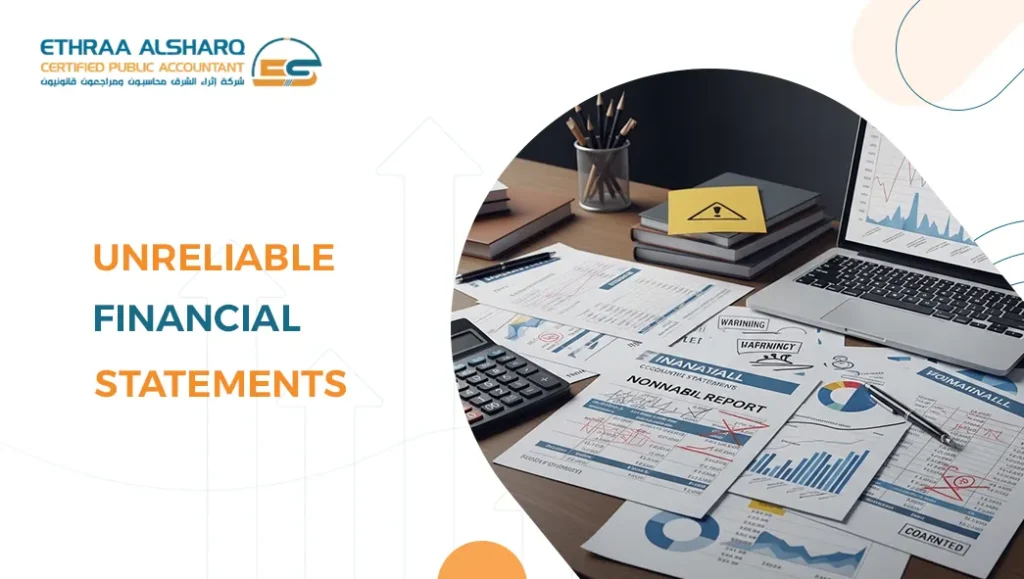
Financial statements are the mirror that reflects a company’s performance and strength. However, in many cases, this mirror can be distorted or misleading.
Relying on inaccurate data when making critical decisions can lead to serious consequences. In this article, we highlight common financial reporting errors and the indicators that put the reliability of financial statements into question.
What Does Financial Statement Reliability Mean?
Financial statement reliability refers to the degree to which users—such as owners, investors, and government entities—can depend on the information presented to make sound economic decisions.
For financial statements to be considered reliable, they must have the following key characteristics:
- Faithful representation: Numbers must reflect the actual financial reality without overstatement or understatement.
- Neutrality: Reports should be prepared without bias or manipulation to present desired outcomes.
- Verifiability: Figures must be supported by documents and evidence that can be reviewed.
- Completeness: All material information that may influence decisions must be included.
In simple terms, reliability is a guarantee that what stakeholders read on paper accurately reflects the company’s real financial position.
Indicators That Financial Statements Are Inaccurate
Business owners or financial managers can identify issues in financial reports through warning signs such as:
- Mismatch between reported and actual balances: Cash or inventory figures that differ from physical reality.
- Reconciliation discrepancies: Failure to match bank balances or differences between recorded and actual supplier and customer balances.
- Unjustified fluctuations in profits: Sudden increases or losses that do not align with business activity or market conditions.
- Inconsistency with operations: Financial growth reported without corresponding operational performance—or vice versa.
Situations That Undermine Financial Statement Reliability
Financial statements become unreliable when there are flaws in accounting processes, including:
- Accounting errors: Incorrect entries or failure to apply double-entry principles properly.
- Lack of adjustments: Missing bank reconciliations or failure to record accrued expenses and revenues.
- Mixing personal and business finances: Personal withdrawals not properly recorded, distorting results.
- Incomplete data: Missing invoices or failure to record certain transactions.
- Delayed updates and misclassification: Accumulated transactions or incorrect classification of assets and expenses.
- Lack of audit and oversight: Absence of internal or external review allows errors to persist.
Common Financial Statement Errors and Their Impact
Accounting errors can significantly affect business strategy:
- Valuation errors (inventory and assets): Overstating inventory inflates profits and increases tax liabilities without real cash flow.
- Unrecorded liabilities: Makes the financial position appear stronger than it actually is.
- Unreconciled balances: Leads to lost receivables and poor cash flow management.
- Misclassification of expenses: Distorts both the income statement and balance sheet.
Importance of Regular Financial Statement Review
Reviewing financial statements is a strategic necessity:
- Ensures tax and regulatory compliance
- Builds investor confidence through transparency
- Supports decision-making based on accurate data
Role of Financial Statement Auditing in Detecting Errors
Auditing acts as the first line of defense against inaccurate financial data:
- Internal audit: Detects operational errors early before final reporting.
- External audit: Ensures compliance with IFRS and verifies data accuracy.
- Enhancing credibility: Increases trust among investors, banks, and regulators.
- Independent opinion: Provides unbiased evaluation and recommendations for improvement.
The Role of Ethraa Al Sharq in Enhancing Data Reliability
At Ethraa Al Sharq, we help protect your business from misleading financial data by:
- Organizing accounting records and correcting classification errors.
- Preparing accurate financial reports (income statement and balance sheet).
- Analyzing performance to identify and address weaknesses.
- Providing financial advisory aligned with IFRS standards.
If you are unsure about the reliability of your financial statements, our team can help review and analyze them to ensure accuracy and support sound financial decisions.
Frequently Asked Questions
When do financial statements become unreliable?
When there are significant discrepancies between records and reality, repeated accounting errors, or missing supporting documents.
Is accounting software alone enough to ensure accuracy?
No. It is a tool that requires skilled professionals to input, review, and validate data.
What is the difference between accounting errors and financial manipulation?
Errors are unintentional mistakes, while manipulation involves deliberate misrepresentation—both reduce reliability.
How can I verify my inventory figures?
By conducting regular physical counts and reconciling them with accounting records.