Successful companies in the Saudi market recognize that bookkeeping is the backbone of their financial stability. It is no longer just routine number recording—it has become a strategic tool that enables businesses to clearly understand their financial position and make decisions based on facts rather than assumptions.
Financial discipline begins with the first entry and ends with a strong financial position that enhances opportunities for growth and investment expansion.
What is Bookkeeping?
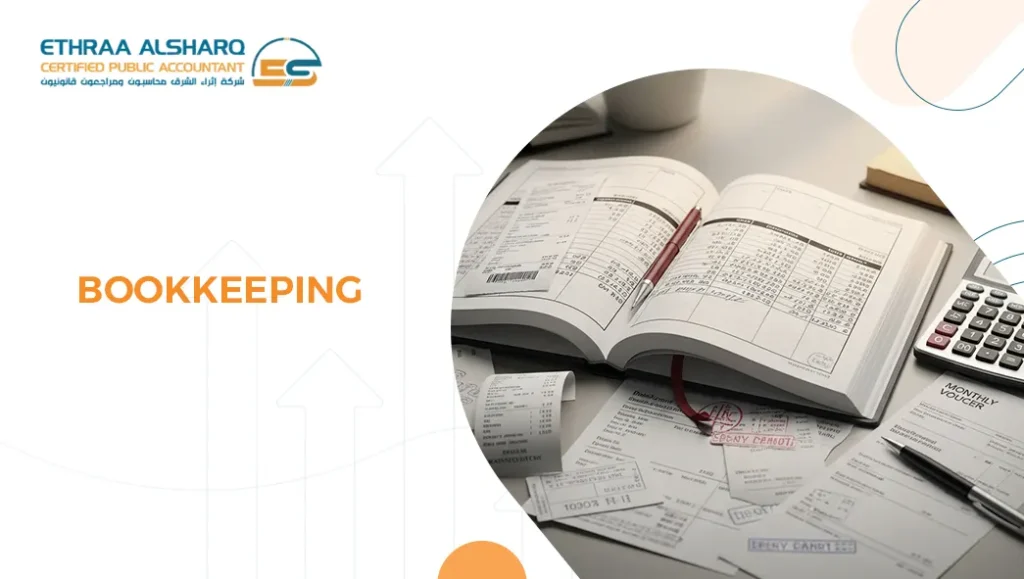
Bookkeeping refers to the process of recording and classifying all financial transactions carried out by a company on a daily and systematic basis.
This includes sales, purchases, expenses, and payments. The goal is not just record-keeping, but ensuring a reliable historical record that can be easily retrieved and analyzed to prepare financial statements in accordance with approved standards.
The Difference Between Bookkeeping and Auditing
It is important to distinguish between these two processes:
- Bookkeeping: An internal and continuous process aimed at recording and organizing daily financial transactions. It forms the foundation upon which financial statements are built.
- Auditing: An external and independent process conducted by a licensed auditor to verify the accuracy of financial records and statements, and ensure compliance with IFRS standards.
Importance of Bookkeeping for Businesses
Bookkeeping goes beyond internal organization and plays a strategic role in ensuring business continuity and legal compliance:
- Supporting decision-making: Provides accurate and up-to-date data for financial planning and investment decisions.
- Regulatory compliance: Ensures adherence to tax and zakat regulations, protecting businesses from penalties and ensuring accurate filings.
- Improving financial control: Reduces the risk of errors, fraud, and financial mismanagement through consistent recording.
- Evaluating financial performance: Helps analyze profits, losses, and cash flows, enabling early detection of deviations.
- Facilitating audits: Organized records make it easier for auditors to review accounts and issue reliable reports.
Types of Accounting Books
Accounting books are categorized into two main types:
1. Mandatory Books
These are required by law to formally document business activities:
- Journal: The primary record where all transactions are recorded chronologically.
- General Ledger: Where transactions are classified into accounts such as cash, bank, and assets, making it easier to prepare trial balances.
2. Supporting Books
These provide detailed operational insights and enhance internal control:
- Accounts Receivable Ledger: Tracks customer balances and collections.
- Accounts Payable Ledger: Monitors obligations to suppliers.
- Inventory Ledger: Tracks stock movement and supports inventory control.
Manual vs Electronic Bookkeeping
Accounting practices have evolved significantly with technology:
- Manual bookkeeping: Paper-based, time-consuming, prone to human error, and difficult for reporting or data retrieval.
- Electronic bookkeeping: Uses accounting software and cloud systems, offering speed, accuracy, automation, data backup, and integration with e-invoicing systems.
When Does Your Business Need Professional Bookkeeping?
There are key indicators that your business needs professional support:
- Business expansion: Increased complexity requires structured accounting systems.
- High transaction volume: Large numbers of daily transactions increase the risk of errors.
- Tax or accounting issues: Gaps in compliance require expert intervention.
- Need for advanced reporting: Business owners require deeper financial insights for strategic decisions.
How to Choose a Professional Bookkeeping Company
Selecting the right accounting partner is a strategic decision. Consider the following criteria:
- Licensing and certification: Ensure the company is officially licensed and compliant with professional standards.
- Industry experience: Choose a provider familiar with your sector.
- Technical expertise: Ability to use modern cloud-based accounting systems and comply with e-invoicing requirements.
- Transparency and communication: Regular reporting and proactive financial advice.
- Data security: Strong protocols to protect financial information.
The Role of Ethraa Al Sharq in Bookkeeping Services
At Ethraa Al Sharq, Certified Accountants and Auditors, we provide more than just transaction recording—we deliver a comprehensive financial system:
- Financial structuring: Designing a flexible chart of accounts tailored to your business.
- Digital transformation: Implementing advanced cloud accounting systems for real-time access.
- E-invoicing compliance: Ensuring full compliance with regulatory requirements.
- Analytical insights: Providing periodic financial reports to support decision-making and profitability growth.
Neglecting proper bookkeeping does not only lead to administrative chaos but also exposes businesses to legal risks and financial penalties.
Bookkeeping is a true investment that gives business owners a clear and secure vision of their company’s future. At Ethraa Al Sharq, we believe your success requires focus on growing your business—while we handle building and managing your financial system with precision and full compliance.
(FAQ)
Is bookkeeping mandatory for small and medium businesses?
Yes, regulations require all businesses, regardless of size, to maintain accurate financial records for transparency and compliance.
How long should financial records be retained?
Financial records and invoices must be kept for at least 10 years to ensure readiness for audits and regulatory reviews.
What is the difference between manual and electronic bookkeeping?
Electronic bookkeeping is now essential due to e-invoicing requirements, while manual systems are no longer sufficient for compliance.
How does bookkeeping help reduce taxes or zakat?
Proper bookkeeping ensures all deductible expenses are documented, preventing overpayment and ensuring fair tax calculations.