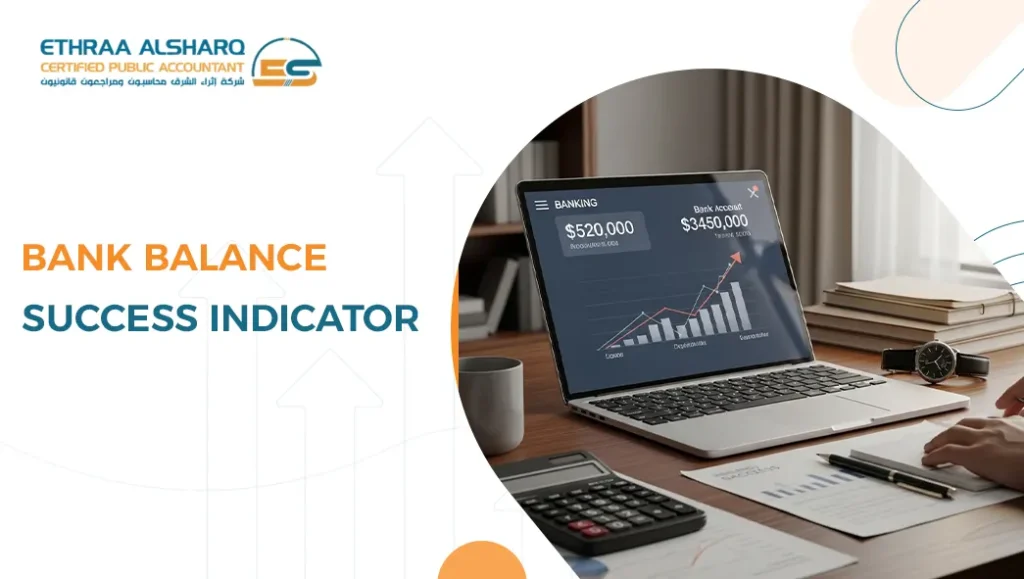
Many small and medium-sized business owners fall into a critical management mistake—measuring their company’s success based on the number shown on their bank account screen.
A high balance may give the impression that everything is going well. However, in the world of finance and business, relying on bank balance as the sole indicator of success is like driving in fog without a dashboard. You may think you are moving at a good speed, but you have no idea when fuel will run out or when you might hit an unexpected obstacle.
In this article, we explain why bank balance can be misleading in the absence of proper accounting records and how to protect your business from this financial trap.
What Does Relying on Bank Balance Mean?
Relying on bank balance refers to making financial and managerial decisions based solely on the amount of cash available in the company’s current account at a specific moment, without considering future obligations or accounting records.
In other words, it treats the bank account as if it were a savings box that reflects net profit, while in reality, it is merely a tool for cash movement.
This approach is based on the principle of “what I see is what I own,” which is flawed in accounting because it ignores transactions that have occurred but have not yet been settled in cash, such as credit purchases or accumulated tax and zakat liabilities that will be due at the end of the financial period.
Why Is Bank Balance a Misleading Indicator?
Relying only on the current account provides an inaccurate picture of the company’s true financial position for several key reasons:
- It does not reflect future obligations: The account may appear full, but it does not show post-dated checks, supplier invoices, or collected VAT that has not yet been remitted.
- Liquidity does not equal profitability: Available cash may come from a bank loan or advance payments for work not yet completed—these are liabilities, not profits.
- No distinction between revenues and expenses: The bank account only tracks inflows and outflows without classification. Without accounting records, you cannot tell whether spending is necessary or wasteful.
- Timing distortion: A high balance may simply mean salaries have not yet been paid or a large one-time payment was received, creating a false sense of financial security.
- No insight into operational performance: Bank balance does not reflect inventory efficiency, customer turnover, or acquisition costs.
Difference Between Bank Balance and Actual Financial Performance
| Aspect | Bank Balance (Liquidity) | Financial Performance (Profitability) |
|---|---|---|
| Meaning | Cash available at a given moment | Ability to generate profit after costs |
| Nature of funds | May include loans or third-party funds | Includes earned revenue minus expenses |
| Reliability | Misleading if liabilities exceed balance | Accurate representation of financial health |
| Decision impact | May lead to spending money not truly owned | Supports informed growth decisions |
The Role of Accounting Records in Revealing Financial Reality
Organized accounting records act as a microscope that reveals details a bank statement cannot show, providing real protection for the business through:
- Accurate transaction recording: Capturing every financial activity (cash or credit) as it occurs.
- Clear profit and loss visibility: Showing true operational results over a defined period.
- Full visibility of liabilities: Identifying all obligations owed to suppliers, employees, and government entities.
- Better decision-making: Providing historical and analytical data for sound investment and expansion decisions.
What Happens Without Proper Accounting Records?
Neglecting bookkeeping and relying solely on bank activity exposes the business to serious risks:
- Incorrect financial decisions: Expanding or investing based on temporary cash availability may lead to financial distress.
- Tax compliance challenges: Lack of proper records makes it difficult to prepare accurate tax and zakat filings, potentially leading to penalties or estimated assessments by authorities.
- Weak financial control: Increases the risk of waste, untracked expenses, fraud, or mismanagement.
- Unexpected cash shortages: Hidden obligations may suddenly exceed available funds, causing liquidity crises.
How to Build an Accurate Financial System Instead
To move from uncertainty to financial stability, businesses must rely on structured systems rather than momentary balances:
- Maintain proper bookkeeping: Record all financial transactions promptly and systematically.
- Use advanced accounting systems: Adopt cloud-based solutions that ensure accuracy and compliance with e-invoicing requirements.
- Prepare periodic financial reports: Generate income statements, balance sheets, and cash flow reports monthly.
- Analyze financial performance: Evaluate profit margins, efficiency, and identify issues early.
- Perform regular bank reconciliations: Ensure alignment between accounting records and bank statements.
The Role of Ethraa Al Sharq in Protecting Your Business
At Ethraa Al Sharq, Certified Accountants and Auditors, we help you move beyond misleading reliance on bank balance by:
- Organizing and restructuring your accounting records according to best practices.
- Preparing accurate financial statements that reflect your true financial position.
- Providing financial analysis that turns numbers into strategic insights.
- Offering expert advice to support sound investment and operational decisions.
If you rely on your bank balance to evaluate your business performance, it may be time to reconsider. Contact our team to gain a clear financial perspective based on real accounting data.
(FAQ)
Does bank balance reflect company profits?
No, it only reflects available cash, not actual profits, which are affected by liabilities and outstanding obligations.
Can a company be unprofitable but still have a high balance?
Yes, due to loans, advance customer payments, or delayed payments to suppliers.
What is the difference between bank balance and cash flow?
Bank balance is a snapshot at a specific moment, while cash flow reflects money movement over a period.
What is the correct way to evaluate financial performance?
By maintaining proper accounting records and regularly analyzing financial statements.
Why do companies need an accounting system?
To ensure accuracy, compliance, and reliable data for decision-making.
Can bank statements be used for tax filing?
No, tax authorities require proper accounting records and tax invoices—bank statements alone are not sufficient.